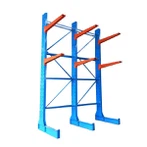
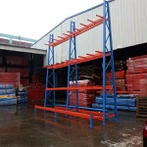
In order to economically and reasonably solve the moisture-proof problem of warehouse storage shelves, and create a good indoor microclimate.
First, it is necessary to study and discuss the mechanism and law of moisture transfer. The moisture transfer itself is a very complicated problem. In order to simplify the calculation in the moisture-proof design and calculation of warehouse shelves, we use the steady-state moisture transfer theory to use high temperature and high humidity. The weather is used as the basis for the design outside the library. Therefore, a reasonable enclosure structure of the warehouse shelf material is selected, and the thickness and arrangement method of the various shelf welding materials are calculated to ensure that the humid air outside the warehouse cannot be transferred to the warehouse in the high temperature and high humidity season, so that the warehouse can guarantee The proper humidity microclimate.
Second, the warehouse must be sealed as a whole. It is difficult to ensure the moisture resistance of the warehouse only by design calculations. It is also necessary to focus on the general layout, the flat profile design of the single unit, the construction and treatment of the enclosure structure (walls, roofs, ground, doors and windows, etc.), as well as the construction technology and construction methods. Efforts have made the warehouse to form an absolute airtight similar to a canned box, so that the moist air outside the warehouse cannot be introduced into the warehouse.
Third, it is impossible to fully meet the requirements in many cases by relying solely on meticulous design and meticulous construction. Some effective management systems and management methods must be adopted. For example, ventilation between storage shelves should be carried out at the right time, auxiliary dehumidification should be carried out when necessary, drainage and leakage repair of the warehouse, and maintenance management of the warehouse should be done at any time.
Fourth, the humidity inside and outside the warehouse, as well as the wind direction, wind speed, air pressure, etc., should be measured regularly and regularly. When conditions permit, the moisture conductivity of the warehouse should also be measured in order to accumulate more moisture-proof test data. Better grasp the moisture-proof law of the warehouse. Only from the comprehensive management of the warehouse's moisture-proof calculation, building structure, careful construction, careful management, and moisture-proof testing, can the moisture-proof problem of the warehouse be solved economically and reasonably.